
Showing posts with label Brazil. Show all posts

Friday, August 31, 2007

Thank You Stern Magazine


Last year in September, Stern Magazine in Germany, assigned me to photograph the first day of school in Brazil. Soon after Carnival I arranged to photograph in the south of Sao Paulo, a very unknown part of the city for its abundant green areas yet very isolated and marginalized. I found a very poor family of four children with a single mother. The father due to alcoholism had abandoned the family.

The family lived in a wooden shack on private land. The landowner, had kindly allowed them to live there without rent. The children I photographed, pictured above with their mother are Daniel and Daniela, seven year-old twins on their way to their first day of primary school. The children must walk three kilometers to the bus stop and then drive another fifteen to an overcrowded public school.

The article was published in late August 2008 in Germany. The readers were moved by the tragedy of this family and voluntarily have begun a to set-up a fund to help them.

I just want to say, that this is what it's all about. This is why I take pictures. So I thank all the people who made this happen, Luis Viera at the social clinic who found the family, the two gentlemen who drove me around, the Instituto Socio Ambiental, Stern Magazine and of course it's readers.

Saturday, May 26, 2007

Bomb Test


The wall in the background, divides the slum Jardim Elivana and separates the housing project, while protecting private land from being occupied. Three weeks ago, the body of a twenty-year old was found along this wall. Almost precisely where the two other children are walking along. Someone had tied a bomb around his waist and then blown him up. No one, really seems sure why they killed him in this manner, what they do know is that this boy was up to no good and got what was coming to him. Revenge? Justice? Murder? This is the life in the periphery. It used to be a lot worse I was told.

Out here it's best to keep the police out of it. Out here the laws are made at home.

Wednesday, May 16, 2007

Looking For A Battle

815 AM. Last stop in the Jardim Pantanal. Will not be back until October.

Sunday, May 13, 2007

Castles

Eight o'clock in the morning. Northern of Sao Paulo, Brasilandia to be exact. Inside the Jardim Elisa Maria neighborhood, a soft fog rolls through the neighborhood. A river, a very polluted one, runs at the bottom of the valley/ A sort of hidden "favela" it is.

These houses reminded me of ancient ruins in the deserts of Morocco. Like homes coming out of the mountain. Caves almost. Will these houses remain 200 years from now? 500? Will someone dig them up or will the city actaully urbanize these areas properly someday? I doubt it.

Sunday, April 22, 2007

Beyond the Roof of the City


It's about to rain and heavily. Some 3,000 families are camped out under improvised plastic tents since March 16, demanding proper housing. They are part of the the MTST (Movimento dos Trabalhadores Sem Teto). The movement has occupied a farm area of over 1,300 square meters, just outside the southern edge of the city of São Paulo, in Itapecerica da Serra. It's a political attempt to further the cause of the lack of proper habitat and part of on going race to reach Labor Day celebrations/protest.

It's sad to see these people here. Most of them really don't seem to know what they're doing. Many come from the northeast. Many have lost their jobs and can no longer pay rent. Others come from the adjoining urbanization and are supporting the movement. Many have abandoned the site too. It's most evident among the hundreds of abandoned single person tents.

The camp includes some small commerce, mostly bars. It's like the begining of another periphery. Yet the illusion is that this is a grand scale occupation when in fact the original 12,000 population has been leaving. The population now floats on a daily basis. However, it's important to note that these people are in dire need of a home and have been flowing from the inner middle of the city and past the periphery. In other words the city may have reached it's denominated urban limit, but the population grows and wants to lay down new concrete that will adjoin to it. The Meta city is growning alive and well.

I walked the camp from edge to edge with "Tres Reais", a sympathetic ex marine corp who abandoned the military, tired of seeing the abuse he had to give to his own people. In fact he himself has participated of various disoccupations. He is here now to fight against that and support the cause. And find a home.

Most of the people I met had the same, perhaps orchestrated answer? "We are here because we are homeless." Some I could admit looked the part. Others, like the young crew cooking barbecue inside a smokey tent, seemed to have come in for a laugh and to add to the list of families. They came from the neighboring urbanization. It doesn't matter really, as if these families are not enough, there are hundreds of them elsewhere in the city in worse conditions.

The rain finally came, in a downpour and with it the wind that lifted a few tents. I took shelter with a family who explained to me how they had lost their rent privileges due to a single delayed payment. Unemployment wasn't helping. The father of the family is mentally incapcitated. The daughter still breast feeding her first born was abandoned by her partner. Like so many other families I have met in the occupations, the female is leading the household.

When I left there was an assembly gathering. A relgious one and a political one to boost morale. The camp is scheduled for eviction on May 7. The MTST is trying to reach an agreement to move them out into an area under the control of the mayor of Itapecerica. Whatever happens, these people will add to the continuous flow and growth of this city.

Saturday, April 21, 2007

Death of the Everyday Man

When death comes, it makes no difference of class, color or creed. It simply takes and leaves behind a carcass to remember. To the poor man in dire circumstances never makes the news and hardly the obituary, unless his death is violent and affects the interests of those who read the or hear the news.

This weekend I've returned to the Jardim Pantanal and death once more circled the neighborhood.

Ivo da Silva was 42 years old and a cook at a fancy restaurant in downtown Sao Paulo. He was run over and fatally killed while riding his bicycle on vacation. The details are sketchy. Ivo was cycling on a busy avenue and was hit by a 19 year old motorist, without a driver's license conducting his ill mother, most urgently, to the hospital in his father's mini public transport bus. The motorist claims Ivo was zig zaging and smashed against the bus. The window shield was smashed and could claim some truth to it. However, the bicycle was intact? The motorist appeared in court with two lawyers. No witnesses were found for the victim's family.

The only truth left is that dead people don't speak.

Ivo, leaves behind three adolescent children and his wife. He was mourned in his home. His body in a cheap and too small a coffin, his feet popped out, was laid out inside his garage. The neighborhood passed to see.

This man arrived in the Jardim Pantanal like thousands of other, some 15 years ago searching for work and place to live. Originally from Pernambuco, he was among the first to begin the occupation, in what used to be an environmentally protected area. A hard working man he had fought several floods to keep his home safe. The Jardim Pantanal continues to be a problem when it rains. The streets still flood and the sewage drains improperly into the Rio Tiete.

The real tragedy is what the family will now have to do to survive. Life claims its debt like it does anywhere else. There are only two ironies. One, out here in the periphery traffic is scarce and so to die of a bicycle accident can only reflect the inherent urban violence. Two, Ivo was an evangelist and on top of him lay a cross with a crucified Jesus.

In death we are at the mercy of all, not just the lord (sic).

Tuesday, April 17, 2007

Water: Guarapiranga and Billings Reservoirs

The Environmental Police department of São Paulo, still military police, were kind enough to allow me a helicopter flyover the Guarapiranga and Billings reservoirs. These natural reservoirs in the extreme south of the city, provide 30% of the city's water supply. Many of my friends and long time residents of the city have never actually been to this part of the city. In part due to its poor access and criminal history (The Jardim Angela, was once declared by the UN as the homicide capital of the world, today gravely reduced thanks to community and state work.) However it is one of the lushest and definitely the greenest area of the city. Rivers and waterfalls stream down into the reservoirs for sailing, water skiing, swimming and for the wealthy who own exuberant mansions on the edge of the natural reserve.

The problem has been the uncontrolled urbanization in many parts of the reservoir. Illegal slum constructions have reached the edge of the water. Since most of these constructions have been built by the owner's accord there's never been an appropriate sewage disposal system installed. The state water company, SABESP, works in the area but takes little providence to control the sewage disposal, claiming.. "If the house isn't registered we don't know about it." In part they are right while in others they have been completely negligent to this growing population. In fact the ISA (Instituto Socio Ambiental) has accused SABESP of actually being the largest polluter of the reservoirs.

As per the urbanization, the police informed me of a ridiculous law that impedes them of taking action against illegal settlements. According to the Brazilian constitution, it is illegal to remove someone from their home. The complications arises because the definition of a home is what is not established. A four walled room with a hay roof yet perhaps with a bed and a washing machine can be considered a legitimate home. However the construction of four roomed house next to the one shack for a family of four there lives, can be demolished. Basically it if has a roof, even if illegal built on natural reservation, the police can't remove it without a judicial order, otherwise its habitat dispossession. All requiring more paper work, more bureaucracy and more social problems to the area. The urbanization along these water marshes produces a large number of quick and cheap construction work. The consequences of which create large illegal disposal sites in the area. The picture above is evidence of the problem. Construction companies in the area as well as the resident will dump their waste here creating hundreds of little white litter mountains on the edge of the reservoir. In fact each little mountain can represent the waste of up to three houses.

It took me over an hour to drive down there from the most southern subway station. The entire area is a series of small densely populated neighborhoods with small roads. It's virtually impossible to patrol these areas without more resources. Even when residents have been informed of their illegal settlement and that they will be evicted and their homes demolished, they take little notice and continue. The fact is that this is only one of the many responsibilities the Environmental Police have.

I'm due back on Thursday for some demolitions.

Monday, April 16, 2007

Santos Dumont Occupation a Farse

Last month I blogged that on Sunday March 25, four occupation movements had taken over the abandoned Santos Dumont hotel. Last night one of my sources, an ex-Prestes Maia occupant and ex-member of the MSTC told me it was an arranged occupation. The four socialist movements involved reached an agreement with the owner to squat the building as long as the cleaned it out of the junkies already squatting and took care of painting and cleaning out the infrastructure. This would explain why the police did not interrupt the occupation when they arrived at the time of the break in. It would further explain why the local newspapers were unable to contact the owner.

It's worth noting that I have received word from some of the residents in the Prestes Maia, that the MSTC is attempting to lure many of the residents into obtaining the R$1800 being offered by city hall and then attempting to charge them of overdue condominium fee. In essence the movement has obtained housing for them and now wants their money?

Sunday, April 15, 2007

Assembly and Sorrow for Samara

I returned to the Prestes Maia that same night for an assembly meeting that would explain to the residents their options for obtaining housing, as described in the previous post. The assembly was led by Jaira, Jo Marina and Yanette an all women team of MSTC leaders. There were a lot less people as you can see.

Yanette made her points and then a series of questions and answers went around. During her presentation she also made note that through the grapevine she's heard of people talking behind her back. Samara, who I photographed last year, was included. In the beginning of February the coordinator on Samara's floor accused her of stealing a bikini, of all things to steal in city! The MSTC leaders searched her shack without warning and in front of her children. Nothing was found. The cocoordinator proceeded to threaten her and accuse her of having sold it already. After the search she returned with Jaira and Jo Marina and physically abused Samara, leaving her with a broken arm.

Days later, under Samara's threat to press charges, Yanette appeared in the building, apologizing and defending Samara. Yanette convinced her not to press charges, alleging it could endanger the negotiations going on at city hall. What I couldn't understand was why now Yanette, with microphone in hand, threatened to punch Samara's teeth out? By the way, the crowd at the assembly cheered on.

All in all it appears to be gossip and jealousy once again taking hold of these people. Samara is good friends with Veronica from the 12th floor. Yanette is dating Veronica's ex. Get the picture?

Samara out of fear for her life and her children, left the building, seek Mauricio her husband at work.

Sunday Mass for the Masses

The Igreja Universal and its Evangelists soldiers are back. I say they are soldiers because they stand at attention outside the Prestes Maia and at church. They also, have a one track mind, Jesus is everything you will ever need they repeat to me. Any time a woman would exit the building, the man at left would signal the woman at left to pursue and attempt to convince her to go to church. There's really nothing wrong with having faith. But as you will see I question the legitimacy of their goals.

I came along because I was hoping to have access to the church. I have been refused to photograph the Igreja Universal ceremonies several times. There's been a long battle with the media accusing them of fraud and manipulation. The truth is that only 10 min. after the beginning of the ceremony the crowd was already marching up the stage to make donations, just like I had seen in the periphery. Little white envelopes full of cash were being dropped into a large glass box. It looked more like Jesus was getting monetary votes of approval. The preacher repetitively revolved his sermon on becasue you give the lord now he will give back. Invest in the lord, he says.

On the bus there I sat next to Maria da Lapa and three of her twelve children. I had not seen Maria in a while. Maria has confessed to being a nymphomaniac. Reason why she is a mother of 12? The eldest married and living in the building too, with her own three children. Maria, lost her home four years ago due to her husband's alcoholism. She was a bit depressed now, even knowing she was going to get an apartment in Itaquera. She kept asking me if I knew of an NGO that could help her get her kids back to school so she could "get them off her back" for a while. Maria doesn't want to work but she did finally confess she's going a crazy with eight children in her single room shack in the Prestes Maia.

When we arrive at the church and before letting the residents off, the soldiers make it perfectly clear that they are here because God wants them to be. There are no coincidences, they say. God wanted you to be here today because it is God who has helped you find a place to live and has commanded that your situation be resolved. As the residents got off the bus, me included, the soldiers blessed us our heads with holy water.


The theatre operatics were at work. I must say the Evangelists make up for the boredom of Catholicism. Going to church here is very participatory. Anyhow I was in and shooting! Ha! I didn't last more than five minutes before the security and a lawyer member pulled me aside to know why I was shooting. It didn't matter that I explained how I was documenting the goals of the Prestes Maia residents and how faith had helped them survive. I needed the permission of the preacher, too busy on stage now and who would certainly tell me I needed permission from central headquarters. I had visited that building in Santo Amaro last year, asking for permission. It looked more like the vautl or general headquarters of multinational. I never got a reply.

The lawyer and second in command here told me to come back next week. They did invite me to stick around for the ceremony. Can't you shoot after the ceremony, outside? they said. Useless I told them, the moment was now. And so, I left. It wasn't long before Helena, who had invited me rushed out to ask me back in. She said, if you can't shoot stay and listen to the lord, he has brought you here for another reason. God wanted you to come church today not to shoot pictures, she insisted.

Tuesday, March 27, 2007

Crackland Is My New Home

On Sunday night, three independent socialist movements occupied the old Santos Dumont hotel in downtown Sao Paulo. The MSTRC (Movimento dos Sem0-Teto da Região Central de São Paulo), the MMRC (Movimento de Moradia da Região Centro) and the MSTC (Movimento Sem-Teto do Centro). The Folha de São Paulo, in their printed version, says nearly 450 families invaded the building while their online version says 400.

I went there Monday night, late. The general assembly had just started. There were barely 200 people there. Perhaps many were out working? It is often the case that the movements overblow the situation to attract media attention and it's more often the case the media don' t bother checking it out. The same situation has been going on in the Prestes Maia 911 for over four years now. Supposedly 468 families have been there since the begining. A tremendous lie fed by both the MSTC and the media. Two hundred and fifty families is more like it.

Anyhow, it was the usual mess. No lights, no water, garbage piles, a burnt out car, food distribution and the heavy speech laid on by the leaders. Fight for your rights to live in a dignified home! Man, the more I look at all this the more political it gets. The movements aren't fighting to get these people homes, they use them for their political means. During the first three years of the occupation in the Prestes Maia, over 80% of the movement living in the building was working for city hall.

This occupation lies smack in the middle of Cracolandia (Crackland) a drug and junkied infested neighborhood. Right across the building is the beautiful Luz train station, completely renovated to its old colonial glory. The city keep promising to renovate the downtown area, but the more buildings get occupied the harder it gets. The people take these buildings because they have somethig solid to hold onto in the downtown area. Something that in one way or another belongs to them, even if its temporary. They know their lives are temporary and could end any second.

Some one hundred crack heads tried to become part of the occupation. They were all refused entry. No drugs and no alcohol is the norm. I have to go back and check it all out again. It's a weird place. It reminds me of the Carandiru prison. It too has a central patio, surrounded by the former hotel rooms, now someone's apartment and home.

Saturday, March 24, 2007

Three for three

I've barely slept and I slept on the concrete floor. Vagner, took me out to check out the local discoteque, Samba Rock was the order. We decided not to go in, next week would be Funky, a hotter thrust of hips. The crowd was huge and the line must have gone down at least a kilometer. You could buy your entrance for US$7.00 but that didn't guarantee you were going to get in. It's full of young males here, probably six for every girl and you can practically smell the testosterone in the air. The girls are all out in threes, at a minimal. Some can barely keep their clothes on. It's not even hot out but in Brazil like in most of the tropics, showing flesh is a natural thing. How come the boys are wearing hoods then?
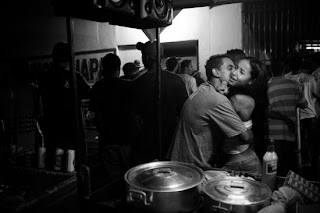
I've spotted a young couple making out. He's completely stoned, his eyes glowing like glass. She's in another state and adoring every bit of his kisses. His hands never leave her. They're making out right in front of Luis, a friend of Vagner, selling corn on the cob. Since we're all enjoying the view, I asked him how come he's not going in. He told me, as he pointed to the corn, someone's got to bring the money home. Are you married? I asked. No, no, no! How about a girlfriend? Yeah, the most beautiful girl in the world, he replied. Since I was out trying to get some research on sexuality I naturally asked him if he had sex with her. Luis was 19. He said no. I said, how come? It's too complicated he told me. Finding a place to do it is really hard out here. My house is always full and her's is impossible. Apparently they've been dating for a year and have been planning it since. I asked him if he was a virgin and he told me very quickly, no and I've only done it once. So, how was it? Very fast. I then asked him if he was planning to use a condom with his girlfriend. He paused to reflect and then said, most likely not. Why? I asked. Man, if you saw her, you'd know. She's beautiful! Any baby coming out of her would be fantastic. I then had to ask, how are you going to raise the child if your finding it so hard to make a living selling corn, have no place of your own and your girl is only 18? Ahhh, that's what out mother's are for. Irresponsible or ignorant?
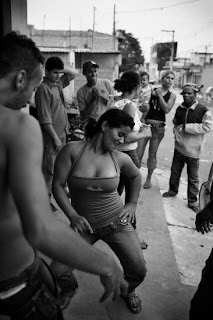
I woke the next morning at 7:30 am. Vagner had to go study for his college admissions. I went round the bend in search of breakfast. I bumped into Cimar, Ze Foguete, some friends and three girls they were trying to get out into the bushes for sex. They'd all been out all night and were highly enebriated and high on coke, probably weed too. They were partying, like everyone likes to do. Recreation out here is hard to find, sex is easy to get but with little privacy, much less any intimacy, booze is around 24/7 and cheap but cocaine or crack is the word. Brazil is the second largest consumer of cocaine in the world. The drug comes through Peru, Bolivia and Colombia before it heads out to the US and Europe. Yet the dealers here don't seem to make a lot of money off of it. Some other big fish is making the money. Here, unfortunately, the dealers sell it and destroy the lives of the neighborhood as amateurs.

The girls are out dancing, strutting their stuff and the boys are out to please. Marlene is in the car, just where the boys want her to be. She's camera shy, but in the end loves the attention. I don't know what to think of it all. I know them. They're wasted, they're young and they all want action. Is it any different than the boys and girls in the upper class neighborhoods? Visually here it just looks more decadent. Yet, they certainly look more alive than the usual crowd in the discos downtown.

Cimar and Ze wanted me to join them. They told me if I wanted some dirty sexy pictures then I should go along for the ride, there would be plenty of panties to shoot. The other friends have gone. It's one girl to each man. The car has only enough gas to go there but not to come back. We're less than a kilometer away. Ze insists I come along so they can do the other girls. I tell him I'm not really interested. He gets a little pissed and calls Marta over to convince me. She approaches me half off her wits, looks me straight in the eyes with a big smile and her hands on my chest. What's the matter, don't you like me? Man!.... Sorry girl, it's none of that, your fine! I lie. I've just got business to do now.

What a lame excuse.

Friday, March 23, 2007

The Preacher and his Wife

The evangelist church of the Assembleia de Deus (Assembly of God), like the Igreja Universal (Universal Church) is scattered through out the periphery slums of São Paulo, in small warehouse like units on almost every block. Some are well established, housing up to 300 people while other smaller satellites have only begun. Each block is a potential target area.

Right on the end of the "Duas Pistas", a long double sided avenue dividing the Jardim Pantanal from the Jardim Helena, lies the Assembly of God. It's also a reunion point Thursdays through Sundays for the the youth to gather, drink, flirt, dance and do drugs. I visited an Assembly of God church on Sunday, amidst the youth gathered outside. With me was Santa, sister of Donizete (the alcoholic I've been photographing) and daughter of Dona Fatima.

The decoration is minimal, but I couldn't help noticing how the altar was red with a white back drop and blue curtain on top. It looked more like a Republican gathering. I was going to photograph the preacher under his permission. Then a guest preacher showed up with his wife. He saw me with the camera and asked me if I took pictures? I said yes. Then he asked me if I was a photographer. Again I said yes. I was afraid he would ask me if I take pictures with the camera. He wanted as he said, "...just take five professional photos. It's for my new CD." Adalberto Junior and his wife, tour the eastern periphery of São Paulo promoting their CD's. His are speeches. Her's are songs for and of Jesus.

Adalberto was an odd character and his wife, to be honest, spooked me. His wife began singing to promote her new CD, US$6.50. Adalberto's speecher were US$5.00. People barely carry a dollar around here. In the meantime Pastor João was busy working the music board and playing guitar and bass for the day. Something like his day off.

Evangelism may not be my cup of tea and the preachers often scream too much and say little. It becomes like a brainwash often, repetitive nonesense. They're not all like that, but for the most part they are hard to follow. However, religion, and pentecoastal for most part in these areas provides food (rice and beans) and hope among the chaos. A great part of the people here suffer from durg abuse, alcoholism, domestic violence, loss and unemployment. The state is absent in all these social problems, but the evangelists are there every night of the week.

Adalbarto might not have made a lot of sense. And he tried childlishly to manipulate the little crowd into buying his CD. Amen!! he shouted, those who want my CD say amen!! No one. He then proceeded to bless pastor João and asked for another amen! Amen everyone shouted. He blessed then churh and asked for another amen!! Amen they all repeated. He then said say amen! if you want my CD or my wife's. The room was silent.

They're poor but they're not stupid Adalberto. I'm going to follow him on tour in exchange for his pictures. Could be quite a show.

Monday, March 12, 2007

Between Jesus and the Vice

It's 7:30 in the afternoon on a Saturday. I haven't been back here in seven months. I know this exactly because Marussia is not pregnant anymore and her baby is only two weeks old. She's 19. Tete's bar has also just closed yesterday after arguing over the rent with Edson. She's moved the bar into a darker part of the slum. It's good for her, there's a lot more alcoholics there, including the seven men there now, all drunk, including her husband. Tete has a thick moustache and she works hard. She worked and made more money as a hairdresser when she had her own beauty salon in the neighborhood. It's dark in this bar, cramped and humid. She left the salon business because like her husband she got lost in the booze.

I move on to Gel's house. He's got a new home and now runs a small theatre company in the back. The house used to be a party salon so he now uses the space for the theater and rents it out for parties too. A rave is about to begin in a couple hours, this time the drug of choice will be ecstasy, not the usual coke and grass. It's a private party, so Gel will lock the door later in the night. No one gets in no one gets out! A young cross eyed samba singer has showed up in a skimpy little outfit. Gel's prey for the night. I'm in a t-shirt, jeans and sandles and feeling comfortable. She's complaining how hot it is. She's begging for the fire to be put out.

The police in the last two months have been hitting hard, cracking down on the noise pollution they say. The neighborhood knows they're cracking down on them and the little fun they have in their lives. This is the periphery of one of the largest cities in the world. Two thirds of a near twenty million population lives on the margins of the city. They occupy it and they live here because when they got here 15 years ago there was nothing but the bush and the Tiete river. It was easy then now it's overcrowded and dangerous.

The Pesquero, slang for a pick up bar, used to lie on the back of neighborhood on the river's edge. The community knows it belongs to the PCC (Primeiro Comando Capital), but it's owners and members are retired. Some weeks ago a young girl turned the mafia boss, Sergio, into the police. The PCC went out on a manhunt to kill her. They killed her alright but she was the wrong girl. The police, under pressure of the newly elected right wing government, cracked down on them. They've know of their activity for some time but the police here have to look the other way sometimes if they want to survive too. The Pesquero was a drug trafficking joint and the best place to pick girls, drunk, stoned and high on expressing their sexuality. Most people told me they shut the place down because the original land owner wanted his land back. Why? Who could benefit from building anything out here?

It's late, past midnight, and I'm searching for Bola, a University of Sao Paulo, social worker student. He lives in the local public library run by a Marxist cultural group. I'll be spending the night there. Bola is hanging out with Wagner and others watching a DVD. I sit in and watch his 56 year old father under a 100W light bulb fixing wrist watches. Tomorrow he'll head downtown to a local street fair. Soon after the movie's over a small rat climbs out the window. Wagner's father starts to train the dog again to learn how to hunt it down.

The next morning I've gone looking for Dona Fia. I bumped into her 44 year old son Donizete. It's almost 11:30 am and he's drunk, can barely speak and much less walk. We head back to his house. One of his younger nieces, Vanessa, has returned to the neighborhood. She used to be part of the PCC until her partners in crime were killed in front of her. Seven days earlier to their death they had robbed a car at gunpoint in the exact same place. Four evangelists were inside. The driver handed over the car and told the assailant that he was handing him over to God. The next time they tried to rob a car, the police were waiting for them. Vanessa managed to get away and soon afterwards became an evangelist.

Her younger brother Eduardo was at the house too. The family lives in adjacent concrete blocks. One each for three sisters, a tiny hole in the wall for Donizete while Dona Fia lives up stairs in a dark brick room. Eduardo had a near fatal motorcycle accident two years ago. He's blind in one eye and partially crippled on one leg. He too was reborn into the Pentacostal faith soon after. Today he's at the house because he's left the temple and some of its followers in brand new Fiat have shown up to try to get him back in. Vanessa told me he's gone back to drug trafficking. The PCC now uses him as a transporter.

Vanessa and him at are odds over family troubles. They love each other but can't resolve their differences as she tries to steer him away from where she almost died. The room becomes an hallucinatory half bible half psychological therapy talk, where only Jesus can provide the answer to the devil's acts here present. The world is coming to an end they keep repeating. Earthquakes, wars, global warming are all signs that Jesus is coming back. Vanessa cries in frustration too because upon her return to the neighborhood, within an hour, her cell phone has been robbed and she has been accused of stealing someones credit card to purchase it. The same people she says have her cell phone.

Saint Mathew is being read by the evangelist couple. The couple describes how they too survived a near death experience where killers came to their house in search of the husband. Jesus of course made sure they were saved. Donizete sits in a corner yelling, "It's all lies". His mother Dona Fia threatens him with a sandal. It all ends in a circle of prayer for the family, for Eduardo, for Vanessa, for Donizete and for the photographer who has joined them on this gathering under the word of Jesus.

Vanessa heads around the corner to the local bar. She's drinking beer with her cousin as her nine month old child sucks on dirty lollipop that has fallen to the ground more times than she has. She tells me she's coming back to the neighborhood as soon as she either leaves her husband or gets him off the drugs. Alex, is at the bar too. He's 21 yrs old. I haven't seen him in seven months and he looks as happy go lucky as ever.

Alex has three kids from three different women. None of them let him see his kids. He became an orphan shortly after his father brought home the AIDS virus to his mother. Alex says his father denied it until he died of AIDS too, shortly afterwards. His father engaged in prostitution regularly. His only family is his older sister, abandoned by her husband with seven children. The eldest seventeen. Alex's new girlfriend has gotten him a job at a chocolate factory where her father manages the place. He's optimistic. Fabiano, a friend of Gel's theatre company is hanging out with Alex at the house with his soon to be wife and her child. She got pregnant when she was 17. I ask them about Jacqueline and her sister Evelayne. I had been shooting Jacqueline shortly after she gave birth at 17. Alex could not recall. I could and how he had hit on both of them. When I showed him the pictures he remembered. He also remembered having slept with both of them.


Sex here is like a cigarette, you have so many of them you only remember those that burnt your fingers, or those you got pregnant. Condoms are so easily available it's not a question of sex education. The girls don't pressure the boys to use them because it's a good way to trap them or to get up on the social scale and pounce around saying your a mother now, an adult, somebody!

Life is short and feeling as much joy as possible is not a priority, it's a right you can't deny yourself here. I stayed on talking about sex and it's meaning. It's wild here, they say, I don't know what to tell you. They kept on drinking cheap wine, the "Nightrain" like stuff Guns N' Roses sings about during their junkie days in Los Angeles. It's well past 4 pm and I'm drunk. Time to get some lunch. I find David and Cimar smoking a joint in the corner. That's another story to tell, but like the local Hip Hop group Os Racionais says, "periferia é periferia... em qualquer lugar" (anywhere you go.. the periphery is the periphery).